A landscape photograph does more than place a scene on a wall. It introduces a second space into the room: a distant horizon, a path leading away, or a wide stretch of water that seems to continue beyond the frame. That visual depth changes how the wall is experienced. Instead of being only a boundary, it becomes an opening for the eye. Coastal photography is especially effective because shorelines often contain strong layers—foreground, water, sky—and a clear transition between solid land and open distance.
The effect depends on how the image guides attention. A photograph taken from a low position may make the sand or rocks feel close, while a high viewpoint can turn waves and swimmers into patterns. A pier leads the eye outward; a headland creates a barrier; a broad sky gives the image breathing room. These are not merely technical choices. They determine whether the scene feels intimate, expansive, energetic, or contemplative. When choosing art for a room, consider the direction in which the image asks you to look.
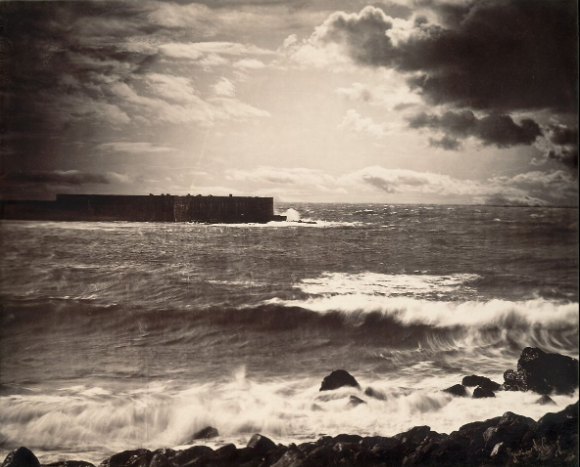
Historical seascape photography offers an instructive example. Gustave Le Gray’s marine photographs from the 1850s were admired for their dramatic treatment of sea and sky. The Metropolitan Museum of Art explains that he sometimes printed separate negatives to achieve a balanced exposure, an approach that helped create a sense of atmosphere that earlier photographic processes often struggled to record. His work shows that the apparent openness of a landscape can be carefully constructed through tone and composition. The Met’s [Mediterranean with Mount Agde](https://www.metmuseum.org/art/collection/search/267425) is one documented example of this approach.
In a living room, a landscape can change the balance between furniture and architecture. A wide photograph above a sofa introduces a horizontal line that relates to the seat and the wall. A vertical image can draw attention upward, which may be useful in a room with a low ceiling or a narrow section of wall. The picture should be considered as a complete shape, including its frame. Use a paper template to judge the proportions before choosing a final size, and view it from the main entry point as well as from the sofa.
A common mistake is to choose art only by the room’s dominant colour. Colour matters, but composition can be more influential. A room filled with low, horizontal furniture may benefit from a tall cliff image; a room with many vertical shelves may feel calmer with a wide horizon. A busy room may need an image with open space, while a sparse room may benefit from a more detailed shoreline. Thinking in terms of visual structure helps the artwork contribute something beyond colour coordination.
Lighting and surface finish affect the sense of depth. Glare on glass can flatten a photograph by reflecting the room over the image, while a matte finish may make it easier to read from different angles. Very dark images can lose detail in dim spaces; pale images may blend into bright walls. Check the picture in the actual location if possible, particularly if the wall receives direct sunlight or sits opposite a large window. A landscape should remain visible without requiring perfect lighting conditions.
A coastal wall art print can bring that sense of depth into a contemporary room, while black-and-white ocean pictures offer a more tonal, graphic approach. The choice should respond to the room’s existing structure: what is too heavy, too flat, too crowded, or too visually narrow? The image should solve a real compositional problem, not simply occupy a blank space.
When landscape photography works, the room feels different without requiring a major renovation. The furniture remains where it was, the wall remains the same size, and yet the eye has a new route through the space. A good coastal photograph offers a kind of borrowed distance. It connects the interior to a landscape that has its own scale and weather, making the room feel less closed in and more connected to the world beyond it.
Think about the route the eye takes from the room into the picture and back again. A foreground element such as wet sand or rocks can make the viewer feel physically close to the scene; a distant headland can create a sense of separation. That relationship may be especially valuable in rooms where every object is near at hand. The photograph offers a shift in scale, allowing the eye to move from the immediate furniture to a landscape that extends beyond the frame. Choose a print with enough clarity for its main forms to remain readable, then give it a position where that visual journey is not interrupted by a shelf or lamp.
That sense of distance is not only visual. It can also create a contrast with the close, practical scale of daily life, giving the room a moment of openness without changing its footprint.