Most people never think about the manholes beneath their streets until a lid rattles under a passing truck or a road closes for repairs. Yet these structures are some of the hardest-working pieces of municipal infrastructure. Many were built of brick or precast concrete generations ago, and a growing number are reaching the point where something has to be done.
Increasingly, the answer is rehabilitation rather than replacement. Here is why.
The Hidden Cost of Leaky Manholes
Sewer systems are designed to carry wastewater, not groundwater or stormwater. When manhole walls crack, joints separate, or mortar washes out, groundwater seeps in. Rain can also pour through vented lids and gaps around frames. Engineers call this inflow and infiltration, or I&I.
That extra water takes up capacity that pipes and treatment plants were never sized to handle. During heavy storms, it can contribute to backups and overflows of untreated sewage, which the U.S. Environmental Protection Agency identifies as a threat to public health and water quality. Even in dry weather, pumping and treating clean groundwater as if it were sewage wastes energy and money.
See also: Planning a Successful Home Building and Renovation Project
Corrosion from the Inside Out
Wastewater produces hydrogen sulfide gas, especially where flows are slow or turbulent, or where sewage has sat for a long time in a force main. Bacteria living on the moist walls above the waterline convert that gas into sulfuric acid. Over time, the acid eats away at concrete and mortar, exposing aggregate, weakening reinforcement, and leaving surfaces soft enough to scrape away by hand. Manholes downstream of pump stations, or at drops and junctions, often show the worst damage.
Why Replacement Is Often the Harder Path
Digging out a manhole means excavating a street, rerouting traffic, working around gas lines, water mains, and communication cables, and managing sewage flow while the structure is removed. It is disruptive for residents and businesses, and it can take weeks. In many cases, the existing structure is still sound enough to serve as the shell for a new interior surface.
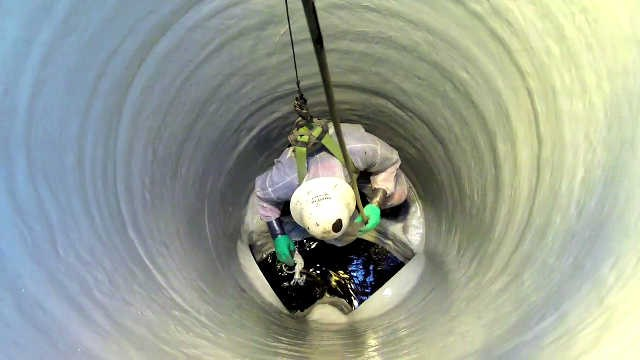
Rehabilitation works from inside the manhole. A crew and its equipment park at the opening rather than beside an open trench, and the job is often finished within a shift or a few days.
Common Trenchless Rehabilitation Options
- Chemical grouting to stop active leaks before any lining is applied.
- Cementitious and geopolymer liners, often spray- or spin-applied, to rebuild lost wall thickness.
- Cured-in-place liners that are pressed against the walls and hardened in place.
- Protective coatings such as epoxies, polyurethanes, and polyureas that create a corrosion-resistant barrier.
- Chimney seals and frame adjustments to address leaks at the top of the structure.
How Spray-Applied Liners Fit In
Spray-applied systems are attractive because they conform to irregular surfaces, including old brick, steps, and benches, without seams. Many cure quickly, which shortens the time a manhole is out of service. Utilities considering spray-applied manhole rehabilitation usually follow a familiar sequence: bypass or control the flow, clean with high-pressure water, stop active infiltration, repair the bench and invert, then apply the liner to a specified thickness.
Quality depends on preparation. A coating applied over damp, contaminated, or crumbling concrete will not bond well. Crews must also follow confined-space entry procedures, since manholes can hold toxic gases and low oxygen levels.
A Longer View of Infrastructure
Rehabilitation is not a cure-all. Structures that have shifted, collapsed, or been badly undersized still need replacing. But for the many manholes that remain structurally intact and are simply leaking or corroding, rehabilitation offers a faster, less disruptive way to extend service life and cut I&I. For cities balancing tight budgets against aging systems, it has become one of the more practical tools available.