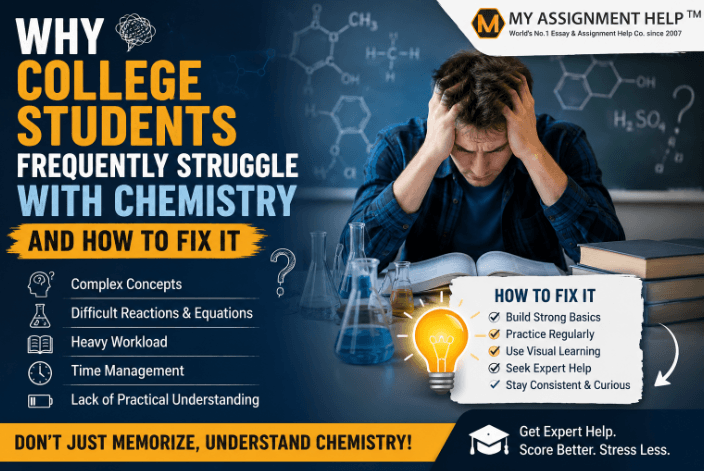
For many college students, stepping into a high-level science lecture can feel like entering a completely foreign country. Among all the science, technology, engineering, and math disciplines, chemistry is notoriously famous for pushing students to their absolute limits. It is a unique subject that requires you to visualize things you cannot see, memorize complex rules, and solve intricate mathematical equations all at the exact same time. This multi-layered demand causes thousands of students to fall behind early in the semester.
The transition from basic high school science to rigorous college-level chemistry is rarely a smooth journey. Professors move through dense chapters at a rapid pace, leaving little room for error or hesitation. When the combinations of confusing molecular structures and massive lab reports become truly overwhelming, looking for external support is a smart way to stay afloat. Utilizing specialized Chemistry Assignment Help from a trusted academic platform like MyAssignmenthelp can provide the personalized guidance and clear explanations needed to break down tough topics and protect your GPA.
Key Reasons Why Chemistry Feels So Difficult
The Abstract Nature of Molecules
A primary reason students struggle with chemistry is that it requires a high level of abstract thinking. You cannot physically see an atom, a covalent bond, or a moving electron with the naked eye. Yet, you are expected to understand exactly how these microscopic entities interact, shift, and combine to form the physical world around us.
Trying to memorize abstract models like orbital hybridizations or stereochemistry pathways without a solid visual foundation leads to immediate confusion. If you cannot picture the concept in your mind, writing a comprehensive essay or solving an exam problem on it becomes incredibly difficult.
The Overload of Mathematical Calculations
Many students enter introductory chemistry classes expecting an experimental science course, only to be surprised by the massive amount of algebra involved. Chemistry is deeply quantitative.
[The Multi-Step Chemistry Problem Workflow]
Step 1: Balance the chemical equation correctly.
Step 2: Convert the given laboratory masses into moles.
Step 3: Use stoichiometric ratios to find the limiting reactant.
Step 4: Calculate the theoretical and actual percentage yields.
From balancing complex stoichiometry equations to calculating pH balances and gas laws, math is everywhere. A single minor calculation error at the beginning of a multi-step problem will completely ruin your final answer, leading to immense frustration during homework sessions.
Overcoming the Toughest Chemistry Milestones
Conquering Organic Chemistry Synthesis
Organic chemistry is often considered the ultimate weed-out course for pre-med and science majors. Instead of standard math calculations, it focuses heavily on spatial reasoning and reaction mechanisms.
Students are forced to memorize hundreds of different chemical reagents and predict how carbon-based molecules will transform under various conditions. Success here requires moving away from rote memorization and focusing deeply on why electrons move from one atom to another.
Balancing Cross-Disciplinary Requirements
Modern science degrees are highly interconnected. A biochemistry or environmental science student cannot just focus on molecular reactions; they must also master data analytics to interpret their laboratory findings.
When a student is buried under lab data and realizes, “I need reliable Statistics Assignment Help to analyze my research variables properly,” academic writing platforms step in to lift the burden. Having access to multi-disciplinary support ensures that a tough data-analysis project does not pull down your overall science grades.
Practical Strategies to Fix Your Chemistry Grades
Treat Chemistry Like a Language Course
You cannot study chemistry the same way you study for a history exam. Reading a textbook chapter the night before a test will not work. Instead, treat chemistry like a foreign language that requires daily practice.
Spend fifteen to twenty minutes every single day drawing structures, naming compounds, and balancing equations. This consistent daily exposure builds strong mental muscle memory, making the concepts feel like second nature when exam day arrives.
Rewrite Your Lecture Notes into Visual Frameworks
Passive reading is the enemy of effective learning. When you review your lecture notes, transform the dense blocks of text into visual study aids.
- Draw out reaction mechanisms using bright, different-colored pens to trace electron movements.
- Create comprehensive flashcards for polyatomic ions and solubility rules.
- Build mind maps that connect different functional groups together.
The physical act of drawing and organizing these concepts forces your brain to process the information actively.
Maximizing Your Laboratory Sessions
Prepare for Your Labs in Advance
Laboratory sessions are a vital part of your chemistry grade, but they can be incredibly stressful if you walk in unprepared. Never treat the lab manual like a cooking recipe that you read for the first time at the lab bench.
Read through the entire experimental procedure the night before. Write down a brief outline of the steps in your notebook and look up the safety data sheets for the chemicals you will be handling. Understanding the experiment beforehand saves time and prevents dangerous laboratory mistakes.
Write Lab Reports with Absolute Precision
A perfect laboratory experiment can still result in a poor grade if your final lab report is messy and disorganized. Ensure your data tables are clearly labeled with correct units of measurement.
Be honest about your experimental errors in the discussion section. Professors do not expect perfect results, but they do expect you to explain scientifically why your actual yield differed from the theoretical calculation.
Conclusion
Struggling with college chemistry is a completely normal experience, but it is a hurdle you can successfully overcome. By shifting away from last-minute cramming, embracing visual study frameworks, treating the subject like a daily language, and leveraging professional academic support when your schedule gets chaotic, you can conquer the complexities of the molecular world and achieve top-tier academic success.
Author Bio
Jack Thomas is a Senior Academic Consultant at MyAssignmenthelp with over a decade of experience helping university students navigate complex academic schedules. He holds a Master’s degree in Education and specializes in developing personalized learning strategies and productivity workflows for modern students. When he is not conducting workshops or guiding students toward academic success, Jack is an avid hiker who enjoys exploring mountain trails and volunteering as a youth mentor in his local community.
See also: The Future of Home Entertainment Tech
Frequently Asked Questions
Why is organic chemistry considered harder than general chemistry?
General chemistry focuses heavily on mathematical formulas and predictable laws. Organic chemistry shifts toward spatial reasoning, 3D molecular structures, and complex reaction mechanisms, which require an entirely different style of abstract thinking and study habits.
How can I memorize chemical formulas and polyatomic ions efficiently?
The best approach is active recall and spaced repetition. Use flashcard apps like Anki, practice drawing the structures from memory, and group ions by their structural patterns and charges rather than trying to memorize a massive list at once.
Can online assignment help services solve complex chemistry lab equations?
Yes. Professional academic platforms work with subject matter experts who hold advanced science degrees. They can break down complex laboratory data, perform precise calculations, and help format comprehensive lab reports according to your guidelines.
What should I do if I get completely stuck on a chemistry homework problem?
Do not stare at the blank page for hours. Break the problem down into what is given and what you need to find. Check your units, look for a similar example in your textbook, or consult an online academic guide to see the structural steps explained.
How much time should I dedicate to studying chemistry outside of class?
Because of the heavy blending of math and abstract concepts, a solid rule of thumb is to dedicate two to three hours of self-study and practice problems for every single hour you spend sitting in a chemistry lecture.